Why we gave every realtor three links instead of one
TL;DR: Most link-in-bio tools give you one URL. We gave every real estate agent three — agentr.ee/yourname, luxr.bio/yourname, and yourname.sellsreal.estate — plus the option for Pro users to connect a domain they own, like yourname.com. The reasoning: a link isn't one-size-fits-all. The URL that belongs on a business card is different from the one that looks best in an Instagram bio, which is different from one that reads like your own website. Rather than force a single link to do every job, we let agents pick the right one for each context — all pointing to the same page. And when an agent connects their own domain, their domain ranks in Google, not ours. In this business, the agent's brand is the business, so it comes first.
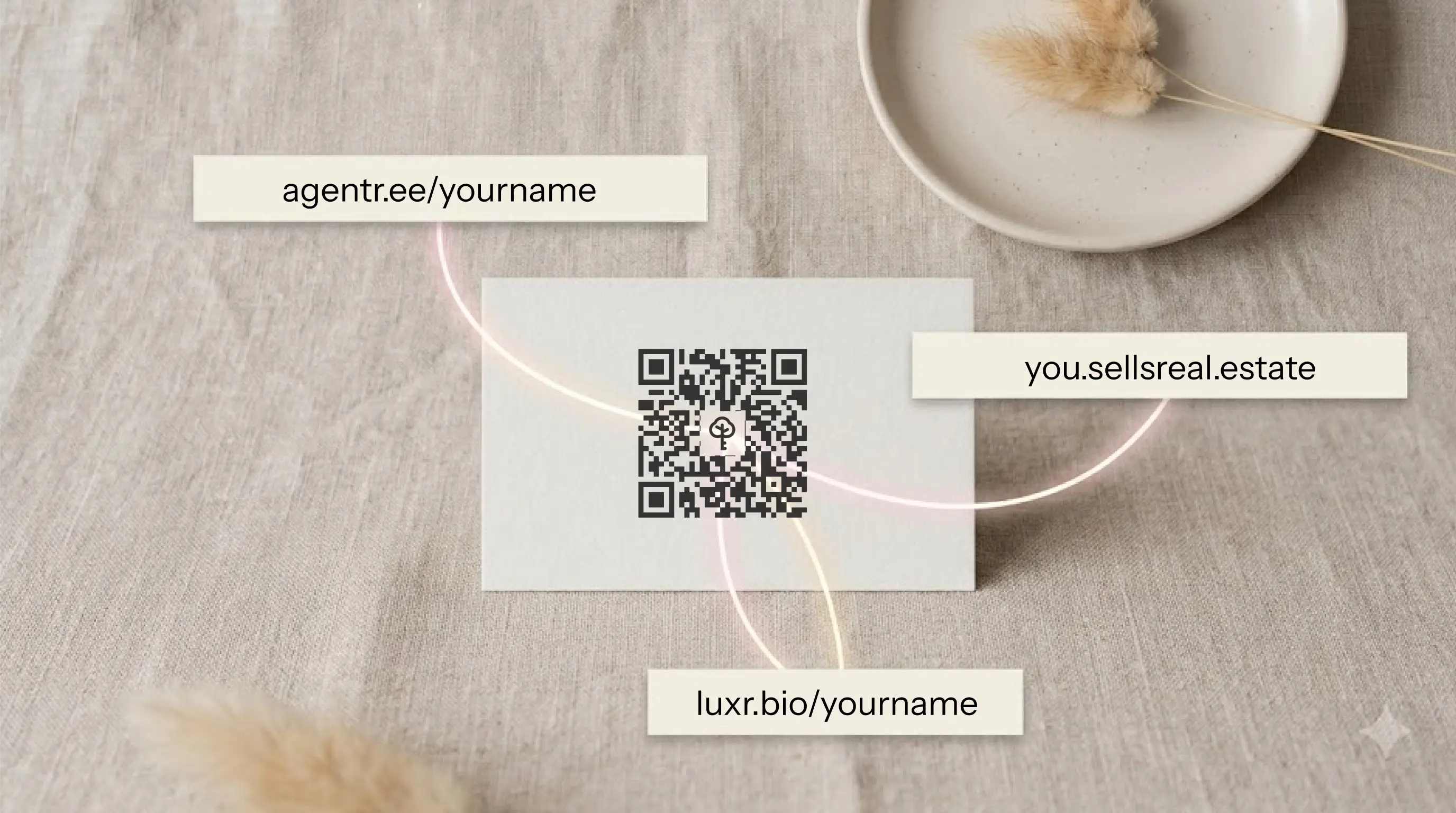
The one-link problem
Every link-in-bio tool works the same way: you sign up, you get one URL, you put it in your bio. Ours was agentr.ee/yourname. Clean, functional, done.
But we kept hearing a version of the same thing from agents: the link doesn't feel like mine. A realtor's entire business is built on personal brand — their name, their face, their reputation in a specific market. Handing them a URL with someone else's brand in front of their name is a small friction, but it's a friction that shows up in the one place it matters most: their Instagram bio, their business card, the link they text a prospective seller.
So we asked a question most tools don't bother asking: what if the link could actually fit the agent, instead of the agent fitting the link?
Why three domains, not one
We now give every agent three ways to serve the exact same page:
agentr.ee/yourname — the classic. Recognizable, tied to the platform, and perfectly good for most people.
luxr.bio/yourname — short, premium-sounding, and built for one specific job: looking good in an Instagram bio. "luxr.bio" reads as luxury and brevity, which is exactly the register a lot of agents want when they're competing on aesthetic.
yourname.sellsreal.estate — this one's different. It's a subdomain, so the agent's name comes first. To anyone glancing at it, janesmith.sellsreal.estate reads like Jane's own website, not a profile on someone else's platform.
Here's the strategic thinking: these aren't three products, they're three contexts. The link an agent puts on a printed business card has different requirements than the one in their Instagram bio, which is different again from the one they want to look like a personal website. Rather than force one URL to do all three jobs badly, we let the agent pick the right tool for each moment. Same page underneath — same content, same everything they've built — just the address that fits where they're sharing it.
It costs the agent nothing and it removes a small but real point of brand friction. That's a good trade.
The subdomain insight
The yourname.sellsreal.estate option deserves a note, because it's the one that surprised us in how well it lands.
A subdomain gives you most of the emotional benefit of a custom domain — your name is the domain — without any of the cost or setup. There's no domain to buy, no DNS to configure, no waiting. An agent picks it in two taps and immediately has a link that reads like their own site.
For a huge number of agents, that's genuinely enough. They don't need to own janesmith.com; they need a link that feels like they own it. The subdomain delivers that for free, which means the more involved custom-domain path is reserved for the agents who specifically want their own registered domain — a much smaller, more deliberate group.
Why we still built full custom domains
For the agents who do want their own domain — janesmith.com, bought and paid for — we built full custom domain support into our Pro plan.
This was the harder decision, because custom domains are genuinely complex to do well. Every custom domain needs its own security certificate, its own DNS validation, its own routing. It's the kind of feature that's easy to demo and hard to run reliably at scale.
We built it anyway, for one reason: for an established agent, their domain is an asset they own and keep. If they ever leave us, their domain and its reputation go with them. Building on janesmith.com is building on their own land. We think that's the right thing to offer an agent who's serious about their brand — even though, honestly, it would be more convenient for us if everyone just used our domains.
We made a deliberate call there: when an agent connects their own domain, their domain is the one that ranks in Google, not ours. That's better for the agent and slightly worse for us, and we chose the agent. It's the same principle behind letting them pick their default link at all — the agent's brand comes first, because in this business, the brand is the business.
What this means if you're an agent
Practically, here's what changed for you:
You can now pick which link is your default — the one we use on your share panel, your QR code, everywhere. Try luxr.bio/yourname in your Instagram bio and see how it looks. Put yourname.sellsreal.estate on your next batch of business cards. They all point to the same page, so there's no downside to experimenting.
And if you own a domain — or you're ready to buy one — connecting it takes a few minutes, and we'll walk you through every step. If the DNS part sounds intimidating, you can hand it off to whoever manages your website with a single click.
Your link should look as good as you are. Now it can.
The bigger principle
Giving agents three links instead of one looks like a small feature. Underneath it is a decision about who the brand belongs to.
A real estate agent's business runs entirely on personal brand — their name, their reputation, their standing in a specific market. Every place we could put our name in front of theirs was a place we chose not to. The default link is theirs to pick. The subdomain puts their name first. And when they bring their own domain, that domain is the one that ranks and the one they keep if they ever leave.
That last part cost us something real: link equity and search ranking that could have flowed to us instead flows to the agent. We chose the agent anyway, because a marketing platform that quietly competes with its own users for brand attention isn't much of a platform. The tool should make the agent look bigger, not the other way around.
If you're an agent: pick the link that fits you, put it everywhere, and if you own a domain, connect it. Your page should carry your name — now it does.