Invisible to Google, Famous to AI: The New Branding Playbook for 2026 Realtors
- Beyond the Blue Link: Traditional SEO is failing because AI assistants like ChatGPT prioritize "Entities" over URLs, making Page 1 rankings secondary to AI citations.
- Lexical Consistency: To avoid "Entity Obscurity," agents must maintain a Global Canonical Truth (one name, one format) across every digital touchpoint to help AI triangulate their identity.
- Data over Fluff: AI models ignore poetic bios in favor of "Data Density," requiring agents to provide structured facts on transaction history, niche specifics, and third-party validation.
- The Technical Moat: Implementing Schema Markup and SVO (Subject-Verb-Object) sentence structures allows AI to map an agent's expertise directly to their name with 100% confidence.
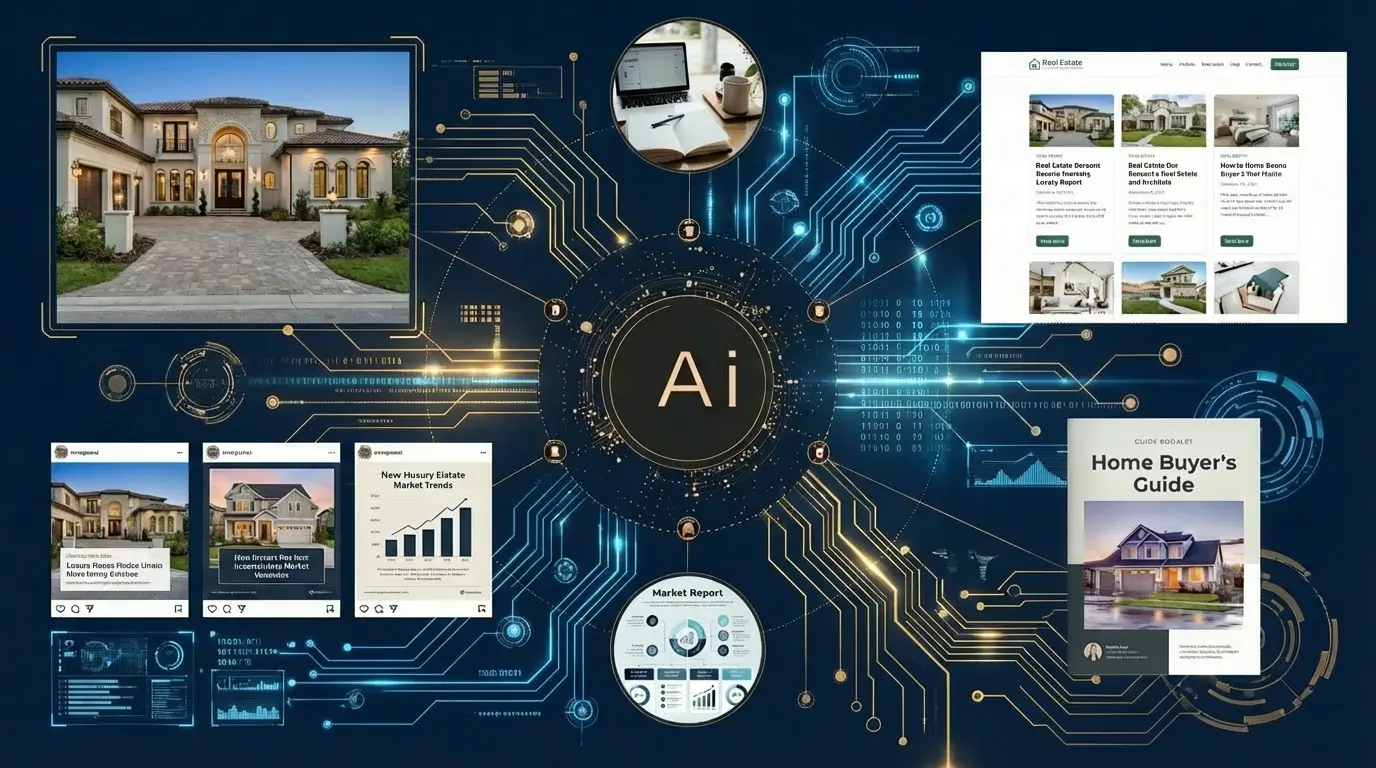
The era of the "keyword-stuffed" website is officially in the rearview mirror.
It is 2026. You’ve spent five years obsessing over backlinks. You’ve curated a blog that ranks on Page 1 for "Best Realtor in Miami." You feel safe. But then, a high-net-worth buyer in London opens ChatGPT and asks: "Who is the top condo specialist in Brickell?" The AI doesn't mention you. It doesn't even know you exist.
Instead, it recommends a competitor who has half your followers and a website that looks like it was designed in 2019. Why? Because you are suffering from Entity Obscurity. While you were busy ranking a URL, your competitor was busy establishing an Entity.
Traditional SEO was a game of tricking a crawler into thinking a page was relevant. The 2026 branding playbook is about Entity Establishment—the process of ensuring you are a recognized, verified "thing" in the AI’s Knowledge Graph. Your brand is no longer what you say about yourself on a billboard; it is what ChatGPT, Gemini, and Perplexity say about you when the human isn't even looking at a screen.
The Problem: From Keywords to Entities
For decades, we’ve been told that "Keywords are King." You sprinkled "Luxury Agent Austin" into your text and prayed to the Google gods. But AI doesn't think in keywords. It thinks in Entities.
What is an entity? It is a unique, well-defined concept or person that the AI can "triangulate." If the AI sees your name as "John Smith" on LinkedIn, "J. Smith Realty" on your website, and "The Smith Group" on Instagram, it doesn't see a top producer. It sees a fragmented mess. It assumes these are three different, less-authoritative people.
To survive the AI era, you need Lexical Consistency. You need a "Digital Birth Certificate." Your Name, Address, and Phone (NAP) must be a "Global Canonical Truth." One name. One format. Everywhere. If you aren't consistent, you are invisible. The AI won't risk recommending an ambiguous source to a user. It wants certainty.
The "Data Density" Strategy
When an AI assistant generates a recommendation, it is performing a high-speed audit of your professional life. It isn't looking for your poetic "About Me" section. It doesn't care that you have a "heart for service" or that you are a "passionate, results-driven professional." To an AI, that is "fluff." It’s noise that gets filtered out in favor of verifiable, hard facts.
To get cited, your website needs to be a structured knowledge base of your career. This is what we call Data Density.
- Transaction History: Stop saying "I sell a lot." The AI can't verify "a lot." List the specific neighborhoods, property types, and price points. Give the machine numbers it can crunch.
- Niche Specifics: AI loves niche authority. If you have 50 articles on "Zoning for ADUs in Los Angeles," you become the Entity for that specific topic. The machine links that specialized knowledge directly to your identity.
- Third-Party Validation: This is your "Trust Score." Mentions in local news, Reddit forums, or industry directories act as verification nodes. The AI sees these and says, "Other humans and entities trust this person; I can too."
Teaching the Machine: Natural Language Processing (NLP)
Most realtor bios are a nightmare for a machine to parse. They are filled with passive voice, complex metaphors, and flowery language. If the AI has to work too hard to figure out what you do, it will move on to someone simpler.
To fix this, we have to write through the lens of Natural Language Processing (NLP). The AI's brain prefers Subject-Verb-Object (SVO) sentence structures. Why? Because SVO is the easiest way to map a person to a skill in a knowledge graph.
Look at your current bio. Does it say: "With a background in finance and a love for the coast, I have spent decades helping families find their dream homes"? That’s the "Bad" way. It’s passive. It’s complex.
The "Good" way looks like this: "Jane Doe is a real estate agent. Jane Doe specializes in luxury condos in downtown Miami. Jane Doe has closed $50M in transactions." It feels repetitive to a human. It feels almost primitive. But for an AI, it is pure gold. It allows the machine to link your expertise directly to your name without any ambiguity. It builds your Entity status with every sentence.
The Technical Moat: Schema and Knowledge Graphs
If you want the AI to "cite" you, you have to give it a map. This is where Schema Markup becomes your unfair advantage in 2026.
By adding RealEstateAgent and Organization schema to your site, you are essentially whispering directly into the AI’s ear. You are providing a structured data layer that eliminates the need for the AI to "guess" who you are using NLP.
You are telling the machine exactly what your social profiles are (using the "sameAs" tag), what specific services you offer, and where you are located. In 2026, if you don't have a "Closed-Loop" schema layer, one that links your site, your Wikidata entry, and your social profiles, you are a ghost. This structured data allows the AI to recommend you with 100% confidence. It’s a technical moat that protects your lead gen from competitors who are still just "collection of links."
Beyond Search: The Era of AI Citations
We are moving away from a "Search" economy and into a "Citation" economy. In a citation economy, your closing ratios are determined long before the lead ever visits your site. They are determined by the AI's confidence in your brand.
Think about the sphere of influence in 2026. It isn't just people who know you; it is machines that recognize you. When you establish your Entity, you are making yourself a permanent part of the digital landscape. You are no longer fighting for a temporary spot in a search result; you are claiming a permanent seat at the AI's table.
Are you a "thing," or are you just a "page"? The answer to that question will define your business for the next decade.
Conclusion: Build Your Entity
Your 2026 branding playbook requires a shift in focus. Stop worrying about "likes" and start worrying about your Entity Association. Does the AI associate your name with "Top Producer"? Does it associate you with your specific "GEO farm"? Every press release, every guest post, and every structured review is a vote for your entity status. When the data on your site matches the data on business registries and social profiles, the graph connects the dots. You move from being just another URL to being an Authority. The era of ranking for clicks is ending; the era of being the "Machine-Readable" answer is here. You don't need to shout to be heard in 2026—you just need to be documented. Build your entity, claim your place in the Knowledge Graph, and let the AI do the prospecting for you.