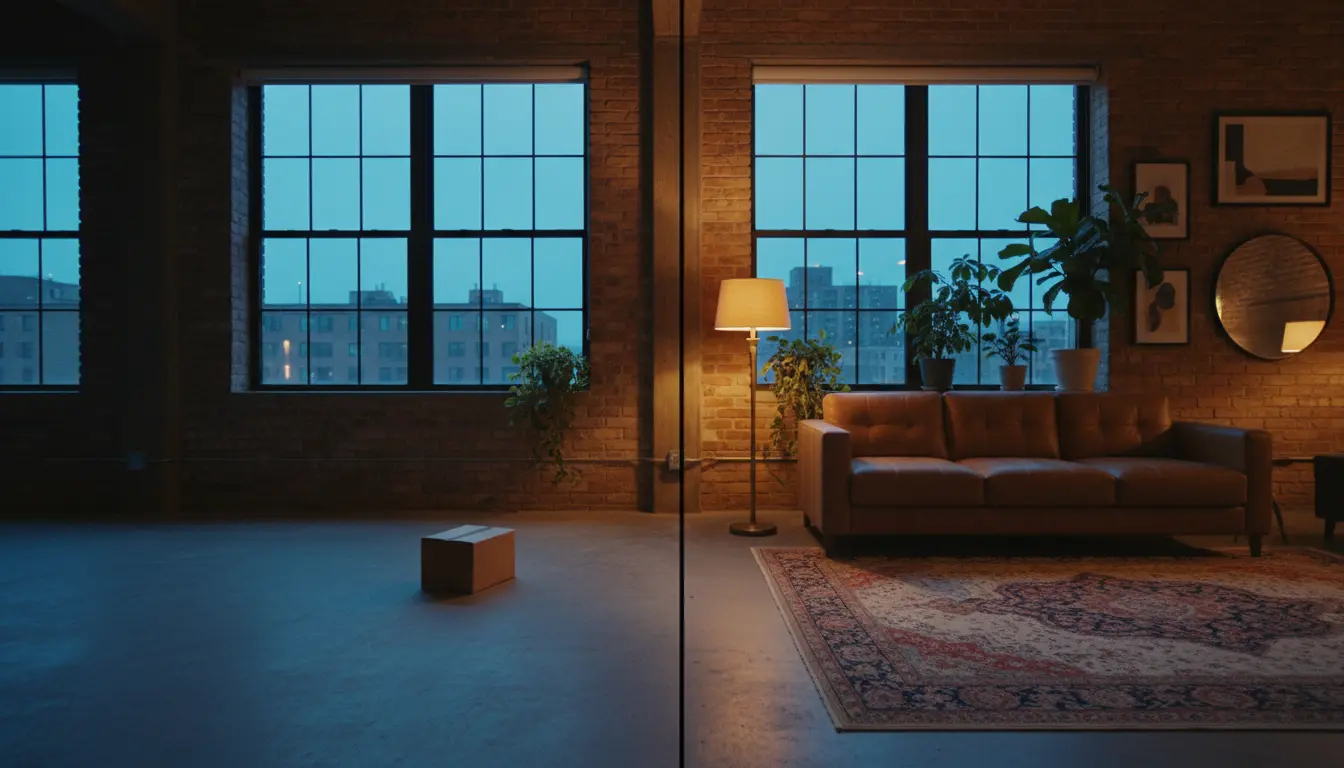
Why AI staging is different from the staging you have been paying for
Traditional virtual staging is a person in a 3D program dropping furniture models into your photo. It is slow and it costs money, but it has one quiet advantage: the person knows not to move the walls.
Image AI does not know that. Tools like Nano Banana, Midjourney and the image features inside ChatGPT and Gemini work in two modes, and you need to know which one you are in:
- Generators make a picture from a description. Great for a Reel background, terrible for a listing, because nothing in the output is your actual house.
- Editors take your photo as the starting point and change what you ask them to change. This is the only mode you should ever use for listing photos.
For listing photos, always edit the real photo. The rule fits in one sentence, and it belongs at the top of every staging prompt you write: keep walls, windows, floor and layout exactly; add only furniture.
The reason it matters is simple. An AI model's whole job is to make a plausible image, and a plausible living room often has a bigger window than yours. Unless you tell it the building is off limits, it will "improve" the building.
The "keep exactly" staging prompt
Attach the photo of the empty room, then paste this. Swap the furniture list for whatever suits the home and the buyer you are targeting.
Keep the walls, windows, floor, ceiling, doors and camera angle exactly as in the photo. Add only furniture and decor: a light grey linen sofa facing the window, a walnut coffee table, a jute rug, two framed abstract prints, a floor lamp in the corner, one potted fiddle-leaf fig. {{style, e.g. mid-century modern}}, neutral palette. Match the existing light direction and shadows. Photorealistic, no structural changes, no new windows.
Three things make this prompt work.
- It lists what must not change before it lists what to add. The model reads the constraint first.
- It names specific furniture. "Nice furniture" gives the model room to improvise. "A walnut coffee table" does not.
- It matches the light. A sofa lit from the left in a room lit from the right looks wrong even if nobody can say why.
When the tool changes the room anyway
It will happen. A doorway moves, a window grows, a closet appears. Do not fight it by editing the result. Go back to the original photo, add one of these lines to the end of the prompt and run it again:
Do not change the building.
No structural changes. The room's architecture is fixed.
If it still misbehaves after two tries, simplify the furniture list. The more objects you ask for, the more the model feels free to rearrange the space to fit them.
A quick photographer vocabulary for rooms
If the staged result looks flat, the fix is usually camera language, not furniture language. Borrow these phrases:
- Whole room with straight walls: "24 mm wide angle, f/8, camera at chest height, verticals straight."
- Bright and airy: "large windows, soft diffused daylight, high-key."
- Cozy evening: "warm lamps on, blue hour outside the windows."
And end every listing prompt with the same negative list, because the model will not police itself:
No extra fingers, no warped walls, no duplicated windows, no text, no watermark.
The other listing edits: what is fine and what is not
Staging is only one of the things buyers see you doing to photos, and the line between a good edit and a deceptive one is not always obvious at 11 p.m. with a listing going live in the morning. Here is the honest version.
Twilight exterior (fine)
A twilight shot is the single best-performing exterior photo on most portals, and you do not need to drive back at 7:45 p.m. to get one. Attach the daytime exterior and use this:
Keep the house exactly. Change the time to blue hour: deep blue sky, warm light glowing from every window, porch light on, subtle wet-look driveway. Photorealistic.
This is an enhancement, not a lie. The house looks like this at dusk. You just did not have to be there.
Green grass, blue sky (fine)
You shot it in February. The buyer is scrolling in May. A sky and lawn swap is standard practice and has been for years in regular photo editing.
Keep everything. Replace the overcast sky with soft blue and light clouds; make the lawn healthy green; keep shadows consistent.
The one caveat is "keep shadows consistent." A sunny sky over a shadowless lawn is the tell that gives away a bad edit.
Declutter (fine, with a disclosure)
Sellers live in their homes, and that means magnets on the fridge and a toaster on every counter. Clearing personal items is fine. Clearing anything else is where it gets risky.
Remove the personal items on the counters and fridge; keep all fixtures and finishes exactly. Do not remove damage or defects.
That last sentence is the whole ethics policy in nine words. The crack in the tile, the water stain on the ceiling and the missing cabinet door stay in the photo. If you would have to disclose it on the seller's property disclosure, it does not leave the picture.
Renovation preview (fine, if labeled "concept")
A dated kitchen is a tough sell, and a "here is what this could be" image is a legitimate marketing tool. The rule is that it must never be mistaken for the kitchen that exists.
Show this kitchen with {{white shaker cabinets, quartz counters and brass pulls}}; keep layout, windows and appliances' positions. Label output "concept."
Post it next to the real photo, never instead of it, and caption it as a concept in plain words. "Imagine this kitchen" is honest. Silence is not.
Floor plan render (fine)
If the listing has a 2D floor plan, you can turn it into a buyer-friendly 3D view in one step:
From this 2D floor plan, produce a clean 3D isometric render with neutral furniture, white walls, light oak floors, soft top-left light.
It does not replace the measured plan, but it makes the layout click for buyers who cannot read one.
The line you do not cross
Every edit above shares the same logic, so here is the logic spelled out for the next time a seller asks you to "just fix that one thing."
- Never remove a defect. Not the stain, not the crack, not the neighbor's RV. Anything a buyer would care about stays.
- Never add a feature the home lacks. No new windows, no fireplace, no bigger closet, no extra square footage hiding in a wider hallway.
- Always label virtual staging and renovation concepts. "Virtually staged" on the image itself, not just in the remarks nobody reads.
- Always keep the original photos in the listing. Staged and unstaged, side by side. The buyer gets to see both before they drive over.
The goal is to help a buyer imagine living there, not to mislead them about what "there" is. A buyer who feels tricked at the showing does not make an offer, and they do tell their friends.
One more thing: MLS rules on virtual staging are specific and they vary. Some require a label on every altered image, some restrict what you can alter at all, and portals have their own policies on top of that. Spend five minutes reading yours before you post the first staged photo. It is a much better use of five minutes than explaining a fireplace.
Sizes and the pre-publish checklist
Export the right size the first time and you will not be re-generating at midnight.
- Listing hero and website: 16:9 at 1920x1080, verticals straight.
- Print flyer: 2:3 or 3:4 at 300 dpi. Generate at the tool's native size, then upscale. Do not ask the model for print resolution directly; it will blur.
Before any staged image goes live, run it past four questions:
- Are the walls and windows identical to the original? Flip between the two. Count the windows.
- Did anything disappear that was a defect?
- Is there a "Virtually staged" label on the image?
- Is the original photo in the listing too?
Four yeses and you are done. One no and you are back to the prompt.
The no-prompt way
If writing all of this out per photo feels like one more job on top of the showings, that is a fair reaction. Agentree's Virtual Staging furnishes an empty room with the walls and windows untouched by default, Listing Tour stitches your photos into a walkthrough video with nothing invented, and your listing page shows the staged and original photos side by side to the buyer who tapped your link. The ethics are built in so you do not have to remember them at midnight.